


- Published on: 22 Dec 2025
- Last updated on: 22 Dec 2025
- Post Views: 767
-

-


Personal loans are popular among borrowers because they are simple, fast, and do not require any collateral. Once you meet your financial needs, the next chapter is to pay the Equated Monthly Instalment (EMI). These EMIs are a fixed part of your monthly budget until the end of the tenure and also affect the cost of borrowing.
During the early months of the loan duration, a major portion of your EMI goes towards the interest. This is why it is important to understand personal loan interest calculation to ensure you plan your repayment wisely.

A personal loan is an unsecured loan where a bank or a Non-Banking Financial Company (NBFC) lends money to a borrower to meet their financial needs. Since it is an unsecured loan, you don’t have to provide any collateral to get access to financing.
As soon as money is disbursed into your bank account, you are entitled to pay fixed monthly instalments over a set duration. Each instalment has two important parts:
At the beginning, a major portion of your EMI goes towards the interest rate. Near the end, however, a bigger portion of your EMI goes towards the principal amount. What this means is that you are paying more interest at the start.
Interest rate is the fixed percentage of money that you pay on the principal amount you have borrowed. The higher the interest rate, the higher the cost of borrowing and vice versa. This is why every borrower must understand the personal loan interest calculation to plan their repayment and ensure eligibility. Here is how a lender (Bank and NBFC) calculates interest:

EMI stands for equated monthly instalment. It is the fixed amount you pay every month until your loan is fully repaid. Each EMI consists of:
In the initial months, a larger part of your EMI goes toward interest. Over time, more of your EMI is applied to the principal. It happens because of the way the personal loan EMI formula works, which spreads interest and principal payments over the loan tenure in a reducing balance manner.
Here is a standard personal loan EMI formula that many lenders use to calculate the monthly payments:
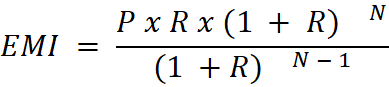
Where:
Suppose that you apply for a personal loan for ₹3 lakh at an interest rate of 14% for 3 years. If you input these values in the formula, here are the results you will get:
This formula helps you calculate EMI accurately. However, manual calculation can still offer inaccurate results if you input even a single wrong value. You can instead use the personal loan EMI Calculator to get accurate results.
Most personal loans use the reducing balance method. It means the interest is calculated only on the remaining loan balance, not the original amount. Here’s how the reducing balance method works:
Example:
In the first month, about ₹1,000 goes toward interest, and the remaining ₹2,321 reduces your principal. Next month, interest is calculated on the smaller balance. It keeps happening every month until the loan is cleared.

Different borrowers may get different interest rates, even though the personal loan EMI formula remains the same. Here are the main factors that affect your rate and EMI:
Prepayment means paying extra money toward your loan before the agreed-upon tenure ends. It reduces your outstanding balance, which in turn lowers the total interest you pay, as per the personal loan interest calculation. There are two types of prepayment:
Understanding how personal loan interest calculation helps you choose the right loan and avoid payment stress. This is why you must always check the interest rate, processing fees, tenure, and prepayment rules before borrowing.
DMI Finance offers personal loans with competitive interest rates and flexible repayment options. You can get a loan amount of up to ₹10 lakh and flexible tenures of 12 to 48 months. With transparent charges and a clear EMI breakup, you always know the exact cost before applying. Apply for a personal loan now.
1. Can my EMI change during the loan period?
Your EMI usually remains fixed, but it may change if you have a floating-rate personal loan and the lender revises the interest rate.
2. Does taking insurance on my personal loan affect my EMI?
Yes. If the insurance premium is added to your loan amount, your EMI will increase.
3. Will delaying my EMI by a few days increase my total interest?
Yes. Late payments come with penalties and extra interest, which increases your overall cost.
4. Can I change my loan tenure after the loan is approved?
Some banks or NBFCs allow tenure changes, but usually only after a few months of on-time repayments and only if you meet their conditions.
5. Does opting for auto-debit help reduce my interest?
Not directly. However, it prevents missed EMIs, keeps your credit score strong, and improves your chances of getting a lower interest rate in the future.
6. Does applying for multiple personal loans at the same time affect my interest rate?
Yes. Multiple loan inquiries in a short time can lower your credit score, which may lead to higher interest rates.
7. Can I change my EMI date after my loan has started?
Some lenders allow you to change the EMI date once or twice, but it depends on their policy and your repayment history.
8. Does missing one EMI affect my future loan eligibility?
Yes. Even a single missed EMI can reduce your credit score and affect your chances of getting a loan at a good rate later.
9. Can I get a lower EMI without increasing my tenure?
You can only reduce your EMI without increasing tenure if you refinance the loan at a lower interest rate.
| Personal Loan of Different Amounts | ||
| ₹50,000 Personal Loan | ₹1 lakh Personal Loan | ₹2 lakh Personal Loan |
| ₹3 lakh Personal Loan | ₹4 lakh Personal Loan | ₹5 lakh Personal Loan |